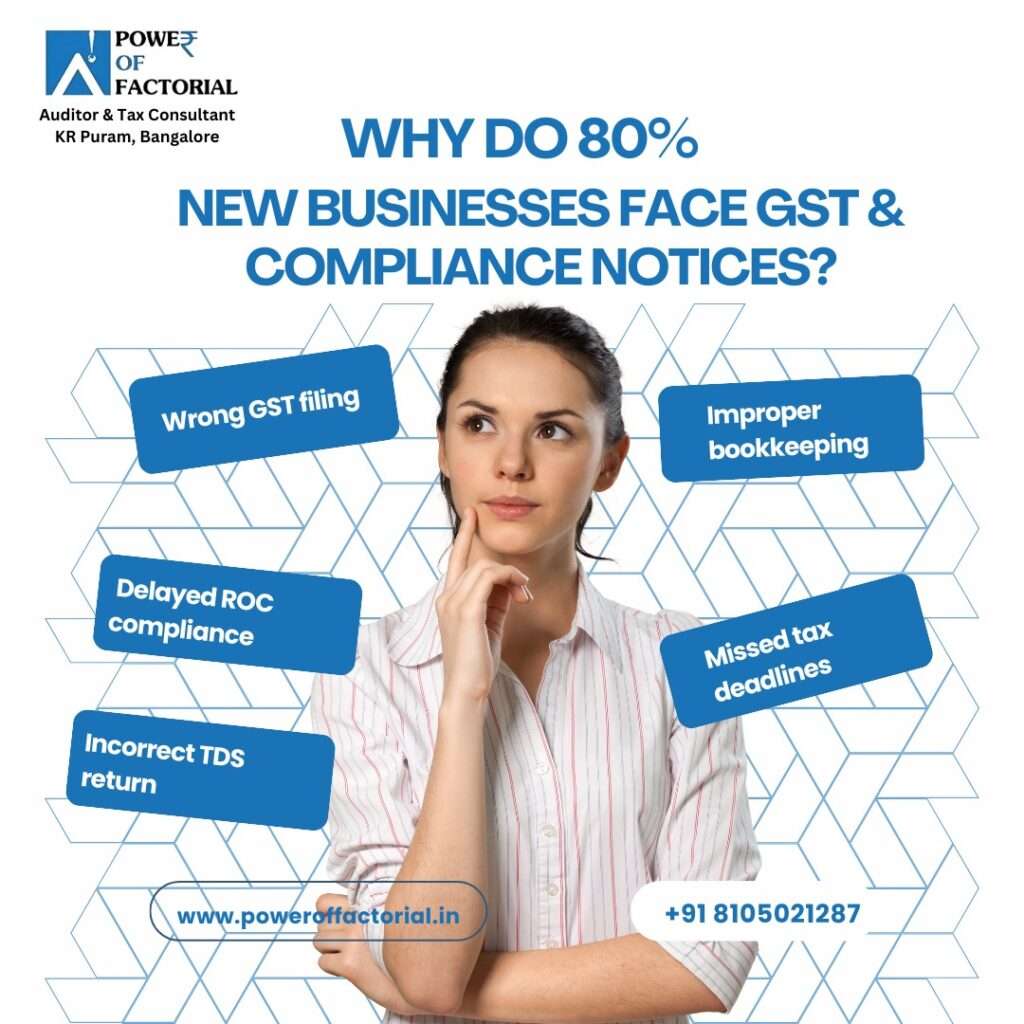
Why Most New Businesses in Bangalore Receive GST & Compliance Notices Within the First Year
Starting a business is a bold decision. You focus on growth, branding, customers, and revenue. But behind the scenes, compliance quietly determines whether your business runs smoothly or faces legal trouble. Shockingly, nearly 80% of new businesses receive GST or compliance-related notices within their first year of operations.
The reason is not fraud. It is not intentional tax evasion. It is simply lack of structured compliance systems. At Power of Factorial Business Solutions, KR Puram, Bangalore, we regularly help startups correct GST mismatches, TDS filing errors, ROC delays, and bookkeeping gaps before they turn into heavy penalties.
1. GST Returns Filed Without Proper Reconciliation
Many new businesses file GST returns in a hurry near the due date. Sales data is estimated, purchase invoices are not fully recorded, and Input Tax Credit (ITC) is claimed without proper verification.
This leads to:
- Mismatch between GSTR-1 and GSTR-3B
- Incorrect ITC claims
- Vendor non-compliance issues
- Automated GST notices
The GST system is technology-driven. Even minor mismatches are automatically flagged. Monthly reconciliation before filing is the only safe approach.
2. Weak or Delayed Bookkeeping
Bookkeeping is the foundation of tax compliance. If your accounts are updated only at year-end, errors multiply across GST, TDS, Income Tax, and ROC filings.
Common bookkeeping gaps include:
- Unrecorded purchase bills
- Cash transactions not properly documented
- No monthly bank reconciliation
- Improper expense classification
Without accurate books, your returns will always carry risk. Proper accounting reduces 70% of compliance-related notices.
3. Missed TDS Deadlines & Filing Errors
TDS compliance is frequently ignored by startups. Many businesses deduct TDS but delay deposit or file incorrect quarterly returns.
Typical TDS mistakes:
- Wrong PAN details
- Incorrect deduction rates
- Late TDS deposit
- Mismatch with Form 26AS
These errors attract penalties and interest. More importantly, they damage your credibility with vendors and employees.
4. Ignoring ROC Compliance
Private Limited Companies and LLPs must comply with ROC regulations annually. Many founders assume ROC filing can wait. It cannot.
Late ROC filings attract daily penalties and may impact director status. During funding rounds or loan applications, non-compliance becomes a serious obstacle.
5. No Structured Compliance Calendar
Compliance failures are rarely due to complexity — they are due to missed deadlines.
Businesses must track:
- Monthly GST due dates
- Quarterly TDS return filing
- Advance tax payments
- Annual Income Tax filing
- ROC annual returns
Without a compliance tracking system, mistakes are inevitable.
How to Avoid GST & Compliance Notices
The solution is simple but requires discipline:
- Maintain real-time bookkeeping
- Reconcile GST before filing
- Deposit and file TDS accurately
- Track all statutory deadlines
- Consult a professional Auditor regularly
Compliance is not an expense. It is business protection.
Professional Compliance Support in KR Puram, Bangalore
At Power of Factorial Business Solutions, we help startups and growing businesses stay compliant, penalty-free, and stress-free.
Our services include GST filing, TDS return filing, Income Tax compliance, ROC compliance management, and complete accounting support.
📞 +91 81050 21287
🌐 www.poweroffactorial.in
Frequently Asked Questions
Why do new businesses receive GST notices?
Due to mismatched returns, incorrect ITC claims, and late filings.
Can compliance notices be avoided completely?
Yes, with structured bookkeeping and professional monitoring.
Is outsourcing compliance better than handling internally?
For most startups, professional handling significantly reduces risk and penalties.