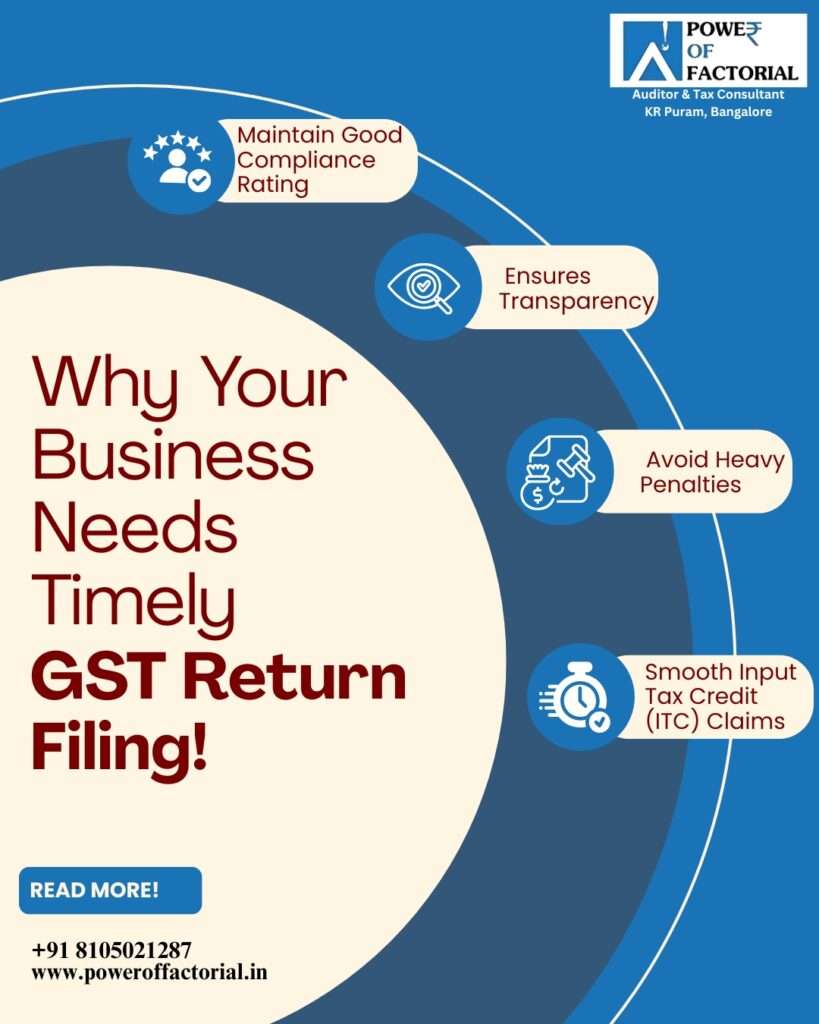
Why Your Business Needs Timely GST Return Filing
Timely GST return filing is not just a regulatory checkbox — it is a strategic business practice that impacts cash flow, credibility, and legal standing. Whether you’re a startup, MSME, or established firm, consistent and accurate GST compliance helps you avoid penalties, claim rightful Input Tax Credit (ITC), and maintain a strong compliance rating.
Quick overview: What is a GST return?
GST returns are periodic statements that businesses registered under the Goods and Services Tax (GST) regime must file to report outward supplies (sales), inward supplies (purchases), input tax credits, and tax liabilities. Returns vary by taxpayer type — monthly, quarterly, or annual — and must be filed within prescribed timeframes to remain compliant.
Top 6 business reasons to file GST returns on time
- Avoid heavy penalties and interest: Late filing attracts interest and penalties that can accumulate quickly. Timely filing prevents unexpected costs and protects profitability.
- Ensure smooth Input Tax Credit (ITC) claims: Accurate and timely returns help reconcile purchases, enabling businesses to claim ITC without delays or disputes.
- Maintain a good compliance rating: Compliance ratings influence vendor credibility and participation in government contracts. A strong rating signals financial discipline and reliability.
- Enhance transparency and audit readiness: Well-documented, timely returns make audits faster and less disruptive. They also reduce the risk of litigation or show cause notices.
- Protect business reputation and vendor relationships: Delays or inaccuracies in returns can strain supplier relationships and lead to hold-ups in procurement or payments.
- Faster loan & financing approvals: Lenders and investors often request GST returns during due diligence. Timely returns accelerate financing decisions.
How late or incorrect returns hurt your business — real impacts
- Accumulation of interest on unpaid tax and penalties.
- Rejection or denial of Input Tax Credit on purchases, increasing tax costs.
- Increased scrutiny from tax authorities and higher audit risk.
- Cash-flow disruption due to unexpected tax outflow or blocked credits.
- Loss of trust among buyers, suppliers, and financing partners.
Step-by-step: Efficient monthly GST return filing process
Follow this practical sequence to make GST filing systematic and error-resistant:
- Collect & reconcile invoices: Gather all outward and inward invoices. Reconcile supplier GSTR-2A / 2B entries with your purchase register.
- Validate tax ledgers: Ensure IGST/CGST/SGST breakups are correctly recorded and tax rates applied match HSN/SAC classifications.
- Claim eligible ITC: Identify and document purchases eligible for ITC and ensure supplier filings support your claim.
- Prepare and review GSTR-1 / GSTR-3B: Draft returns, cross-check totals and note any adjustments for credit/debit notes.
- Approve and generate payment challan (if applicable): Pay tax dues on time using the relevant challan or ledger adjustments.
- File return & archive supporting documents: File within due date, save acknowledgement, and archive all invoices and reconciliations for statutory timelines (generally 6 years).
Practical GST filing checklist (printable)
- All sales invoices uploaded and categorized (B2B / B2C / Export / Reverse Charge)
- Purchase register reconciled with supplier filings
- Credit/debit notes accounted for
- HSN / SAC codes verified for high-value items
- Advance receipts & advances adjusted correctly
- Tax payments and challans ready (if tax payable)
- GSTR-1 / GSTR-3B drafted and signed-off by authorized person
- All supporting documents archived (invoices, e-way bills, payment proofs)
Common mistakes to avoid
- Poor invoice management: Missing or misfiled invoices cause reconciliation failures and ITC denials.
- Incorrect HSN/SAC codes: Leads to wrong tax rates and disputes during audits.
- Failing to reconcile supplier data: If suppliers don’t file or their filing mismatches, your ITC can be blocked.
- Not accounting for reverse charge: Liabilities under reverse charge must be tracked and paid separately.
- Overlooking amendments & credit notes: These adjustments must be reflected in the returns of the relevant period.
Technology & process tips to reduce filing time
Use an integrated approach combining accounting software, GST reconciliation tools and a disciplined month-end routine:
- Automate invoice capture (OCR) and ledger posting.
- Schedule weekly reconciliation checkpoints (not just month-end).
- Keep vendor communication channels open to resolve mismatches early.
- Use version-controlled spreadsheets or an ERP module to track changes.
How a professional compliance partner helps
Engaging a specialist firm like Power of Factorial Business Solutions brings domain knowledge, faster reconciliation, and reduced compliance risk. Key benefits:
- Dedicated GST experts to reconcile supplier returns and advise on ITC claims.
- Accurate classification of goods & services with HSN/SAC guidance.
- Timely filing, payment reconciliations and audit-ready documentation.
- Support in responding to notices and managing retrospective amendments.
Contact details you can place here: +91 8105021287 | www.poweroffactorial.in
SEO & content tips for businesses publishing GST-related content
- Target long-tail keywords such as “how to claim ITC on purchases” or “GSTR-3B filing checklist for small business”.
- Use structured data (FAQ schema) to appear in rich snippets and boost CTR.
- Publish regular, practical articles that answer specific taxpayer pain points.
- Link to authoritative policy pages for credibility and to help readers verify rules.
Frequently Asked Questions (FAQs)
1. What happens if I miss the GST return due date?
Missing the due date can attract interest on the unpaid tax and penalties. Repeated defaults can lead to notices, higher scrutiny, and adverse compliance ratings. Always file as soon as possible and pay any tax due to minimize interest.
2. Can I claim Input Tax Credit (ITC) if my supplier has not filed their return?
ITC is allowed only if the supplier has uploaded the corresponding outward supply in their return and other statutory conditions are met. If the supplier hasn’t filed, reconcile with them and keep documentary evidence; in some cases, ITC may be blocked until supplier compliance is corrected.
3. How often should I reconcile purchase invoices?
Weekly or fortnightly reconciliation is best practice for businesses with a high volume of transactions to catch mismatches early. At a minimum, reconcile before filing monthly/quarterly returns.
4. What documents should I keep for audit purposes?
Keep copies of all sales and purchase invoices, debit/credit notes, payment proofs, bank statements, e-way bills, and reconciliation reports. Statutory retention is typically up to six years from the relevant financial year.
5. How can Power of Factorial help with my GST returns?
We provide end-to-end GST support: invoice reconciliation, ITC optimization, timely return filing, tax payment assistance, and representation during audits or notices. Our team helps create a repeatable month-end process so your compliance is predictable and error-free.