Skip to content
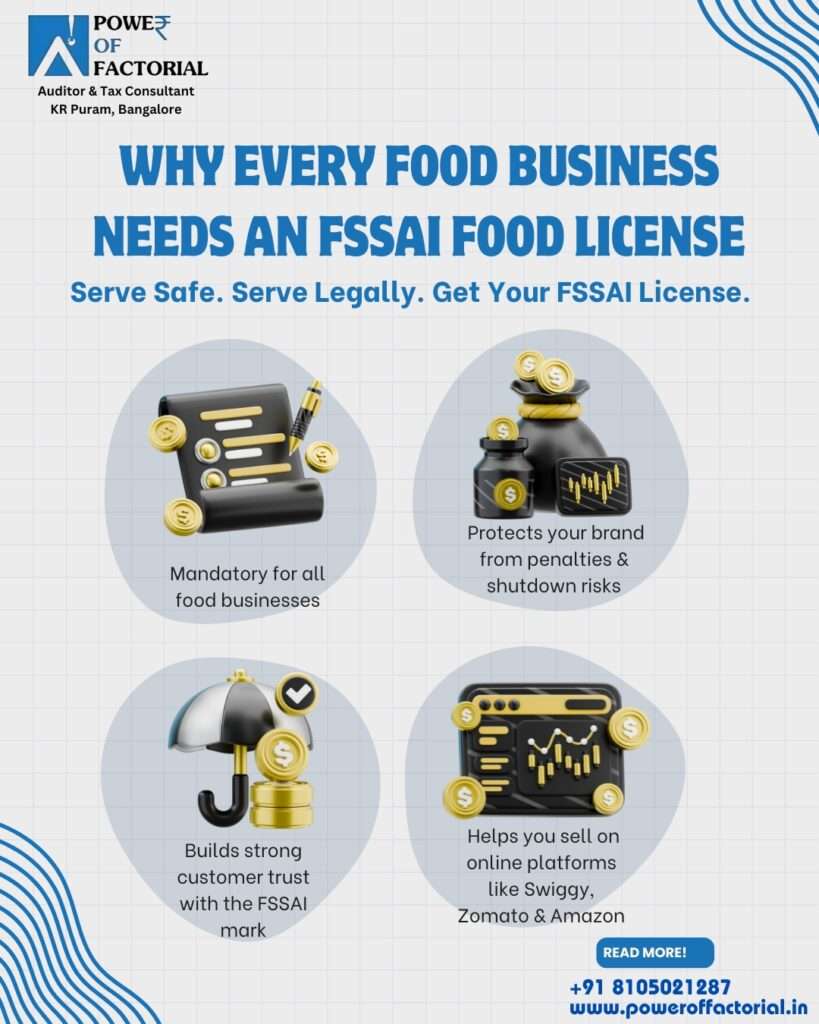
Why Every Food Business Needs an FSSAI Food License
If you run a food business—whether a restaurant, cloud kitchen, home bakery, café, catering service, food stall, or packaged food company—an FSSAI Food License is mandatory. It ensures legal compliance, builds customer trust, enables online sales, and protects your business from penalties or shutdown risks. This guide explains why every food business in India must have an FSSAI license.
1. Mandatory for All Food Businesses
The Food Safety and Standards Authority of India (FSSAI) requires every food-related business to obtain an FSSAI registration or license. Operating without a license can lead to legal penalties, fines, and even closure of the business. Whether small or large, every food business must comply.
2. Protects Your Brand from Penalties and Shutdown Risks
An FSSAI license safeguards your brand by ensuring your business meets hygiene and food safety standards. Regular checks and compliance reduce the chances of legal issues, product seizures, or shutdowns. It also helps maintain long-term brand credibility.
3. Builds Strong Customer Trust with the FSSAI Mark
Consumers prefer food products and outlets that display the FSSAI mark. It acts as a trust badge that your food is safe, hygienic, and meets regulatory standards. For packaged food businesses, the FSSAI number displayed on labels greatly improves customer confidence.
4. Helps You Sell on Platforms Like Swiggy, Zomato & Amazon
Online food delivery apps and e-commerce platforms require sellers to have a valid FSSAI license. Without it, you cannot onboard your products or restaurant on Swiggy, Zomato, Dunzo, BigBasket, or Amazon Food. An FSSAI license gives you instant access to online and aggregator marketplaces.
Types of FSSAI Registration
1. Basic FSSAI Registration
For small food businesses and home-based sellers with a turnover below the FSSAI threshold.
2. State FSSAI License
For medium-sized businesses with higher turnover, operating within one state.
3. Central FSSAI License
For large-scale manufacturers, importers, exporters, or businesses operating across multiple states.
How to Apply for an FSSAI License
Step 1: Identify Your Business Category
Choose Basic, State, or Central license based on turnover and business size.
Step 2: Prepare Required Documents
- Owner’s ID and address proof
- Business address proof
- Food Safety Management System plan
- List of equipment (for manufacturers)
- Photos of the business premises
Step 3: Submit Application Online
Fill out the application form and upload documents on the FSSAI portal.
Step 4: Inspection (If Required)
For State and Central licenses, the authorities may inspect your business premises.
Step 5: Receive Your License
Once approved, you will receive an FSSAI license number that must be displayed at your business location and on food packages or menus.
Frequently Asked Questions
Who needs an FSSAI license?
Any business involved in manufacturing, storing, distributing, or selling food must obtain an FSSAI license.
Can home-based food sellers apply?
Yes, home bakers, homemade snack sellers, and cloud kitchen owners can apply for Basic registration.
Is FSSAI required for online selling?
Yes, platforms like Swiggy, Zomato, and Amazon Food mandate FSSAI registration for onboarding.
Get Help with FSSAI Registration
Power of Factorial Business Solutions, KR Puram, Bangalore, provides end-to-end assistance for FSSAI registration, renewals, and compliance support.
Contact Us:
Phone: +91 8105021287
Website: www.poweroffactorial.in